The first era runs from the top-down original and its London expansions through GTA2's retro-futurist Anywhere City and GTA III's 3D Liberty City. It is the foundation of the entire series: steal cars, take jobs, outrun the consequences.
1997–2001GTA VI / LeonidaClaudeCatalinaClaude Speed
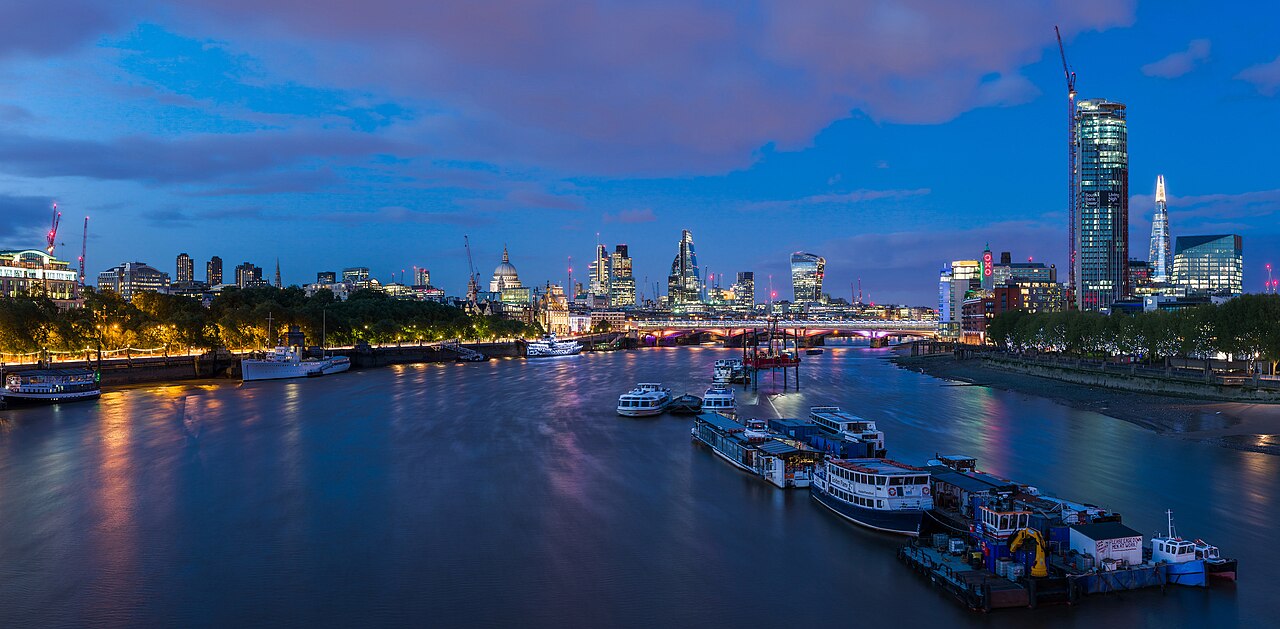
Real-world inspiration, not game artwork. Photo: Diliff (CC BY-SA 3.0) · source
Lore files
location
Liberty City, 1997
The original Liberty City was a top-down grid of three islands, built for short, chaotic crime sprees rather than a cinematic story. Its paper-thin premise — rise through the criminal ranks by any means — set the template the series would spend decades refining.
Adapted from Wikipedia, "Grand Theft Auto (video game)" · CC BY-SA 4.0 · changes may have been made.
The London expansion traded Liberty City for a period British capital of tight streets, mod culture, and very different cars. It was an early sign that the series could reskin its formula around a specific place and era instead of just another American city.
Adapted from Wikipedia, "Grand Theft Auto: London 1969" · CC BY-SA 4.0 · changes may have been made.
A top-down crime spree in a city still rebuilding itself. Small crews, borrowed cars, and a lot of bad decisions.
The London expansion strips the series back to period cars, tight streets, and a pre-Beatles underworld. It is less a franchise milestone than a proof of concept: the same chase loop, transplanted into a colder city.
1969 Swinging London, wrong side of the river
Grand Theft Auto: London 1969
The expansion moves the clock forward and the attitude up. British cars, British gangs, and a city that never quite looks away.
London 1969 leans into the visual language of the era — minis, mods, and a soundtrack of period pastiche. It remains one of the series' strangest side streets: a full GTA game built as an expansion.
1997 Liberty City, top-down
Grand Theft Auto
The original crime spree begins: steal cars, take jobs, and climb a ladder made of other people's mistakes.
The first GTA established the template: a nameless criminal, a city grid, and a radio dial. Liberty City is the starting point, but the game quickly moves through San Andreas and Vice City, treating each as a new playground.
1997 Three cities, one getaway
Grand Theft Auto
The original game's campaign spans multiple cities and ends in the kind of chase that defined the series.
GTA's structure was already episodic: jobs, betrayals, and a final run for freedom. The details are sparse by modern standards, but the rhythm — plan, drive, improvise — is recognisably the series' DNA.
1999 Anywhere City
Grand Theft Auto 2
A retro-futurist city, three gangs, and a protagonist with no name and no patience.
GTA2 leaned into dystopia: corporations, gangs, and a city that feels permanently on the edge of collapse. The game's reputation system and gang loyalty mechanics were early attempts at the living-world design the series would later refine.
2001 Claude is betrayed
Grand Theft Auto III
A bank job, a girlfriend with a gun, and a prison transport that does not go as planned. Liberty City goes 3D.
The opening of GTA III is still one of the series' cleanest setups: Catalina shoots Claude, leaves him for the police, and accidentally creates a free agent. The rest of the game is Claude climbing back through Liberty City's criminal hierarchy.
2001 Working for the families
Grand Theft Auto III
Claude becomes useful to the Leone family, the Triads, and everyone else with a job that needs doing.
GTA III's middle act is a tour of Liberty City power: the Leone family, the Colombian Cartel, the Yakuza, and a media circus. Claude's silence makes him a perfect contractor and a complete mystery to everyone around him.
2001 The Cartel war
Grand Theft Auto III
Catalina returns with a cartel, a hostage, and a very personal score to settle.
The Cartel arc turns the game's opening betrayal into a full-scale war. Asuka, the Yakuza, and the Colombian Cartel all collide, and Claude becomes the one variable nobody can control. The city gets louder and more dangerous.
2001 The exchange
Grand Theft Auto III
A final deal, a final betrayal, and a Liberty City that keeps running long after the credits.
The ending of GTA III is deliberately cold: Claude survives, Catalina does not, and the city absorbs another story without changing its expression. It set the tone for every GTA ending that followed.
A partial, fan-made dossier. Not every game, character, or location is covered. Unofficial fan project. Not affiliated with, endorsed by, or sponsored by Rockstar Games or Take-Two Interactive. The games and their lore are not my work and are not part of any project I own or claim. All game names, characters, locations, and trademarks belong to their respective owners. Summaries are original or adapted from CC BY-SA sources; see each entry's attribution and source links.